Long-Awaited Thomas St. Testing Results Reveal Significant Contamination in “Area A”
- Dioxin, Thomas Street
- February 2, 2026
This post has been updated to also include soil sample TS-SS-SB-3 at a depth of 18 to 20 feet which had a dioxin TEQ of 2603.34 ng/kg
According to information recently posted on the DNR’s public-facing database of contaminated properties, test results from Thomas Street Corridor soil and groundwater samples contain levels exceeding the DNR’s regulatory limits for multiple contaminants. The samples were apparently collected in August 2025, and the environmental consultant’s assessment and commentary related to the test results can be found in the Phase II Environmental Site Assessment submitted to the DNR. That specific report can be reviewed on, and downloaded from, the DNR’s BRRTS website. It is also embedded in its entirety at the bottom of this post.
As noted in a February 2, 2026 DNR email to the City of Wausau, which can also be reviewed on the BRRTS website, out of the four areas or zones tested along the street (Areas A through D), only “Area A” had concentrations of contamination high enough to demonstrate that a discharge of a hazardous substance had occurred which warranted further investigation and cleanup under Wisconsin statutes. Due to contamination levels reported, the test results and environmental investigation resulted in Thomas Street’s Area A becoming a new Environmental Repair Program (ERP) site under DNR oversight. ERP sites typically involve a Responsible Party Letter from the DNR but, as of writing this post (afternoon of 2/2/26), no such letter is listed on the ERP site’s page.
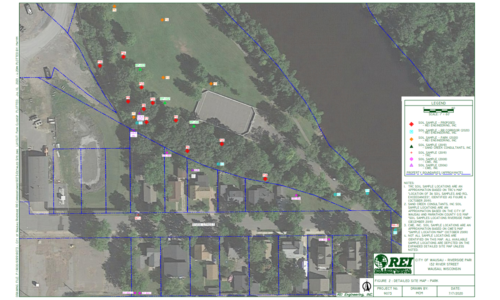
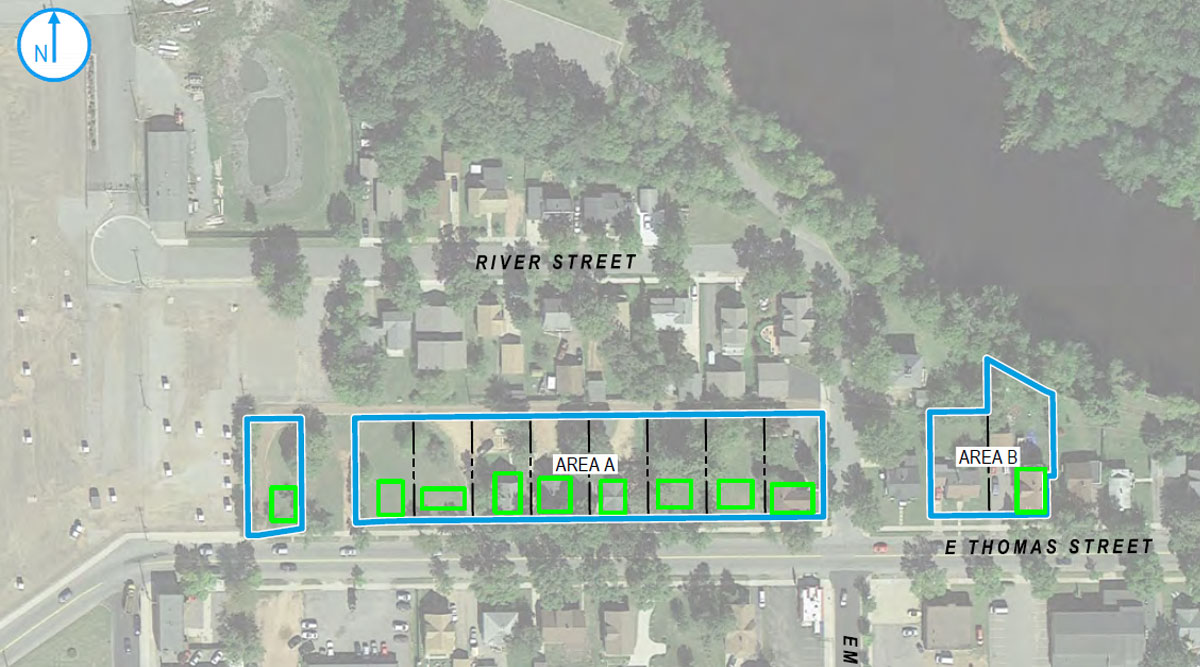
Area A is the block located immediately east of the Wauleco site, as can be noted on the site layout map of regulatory exceedances from the Phase II investigation. One can click the image to view a larger map.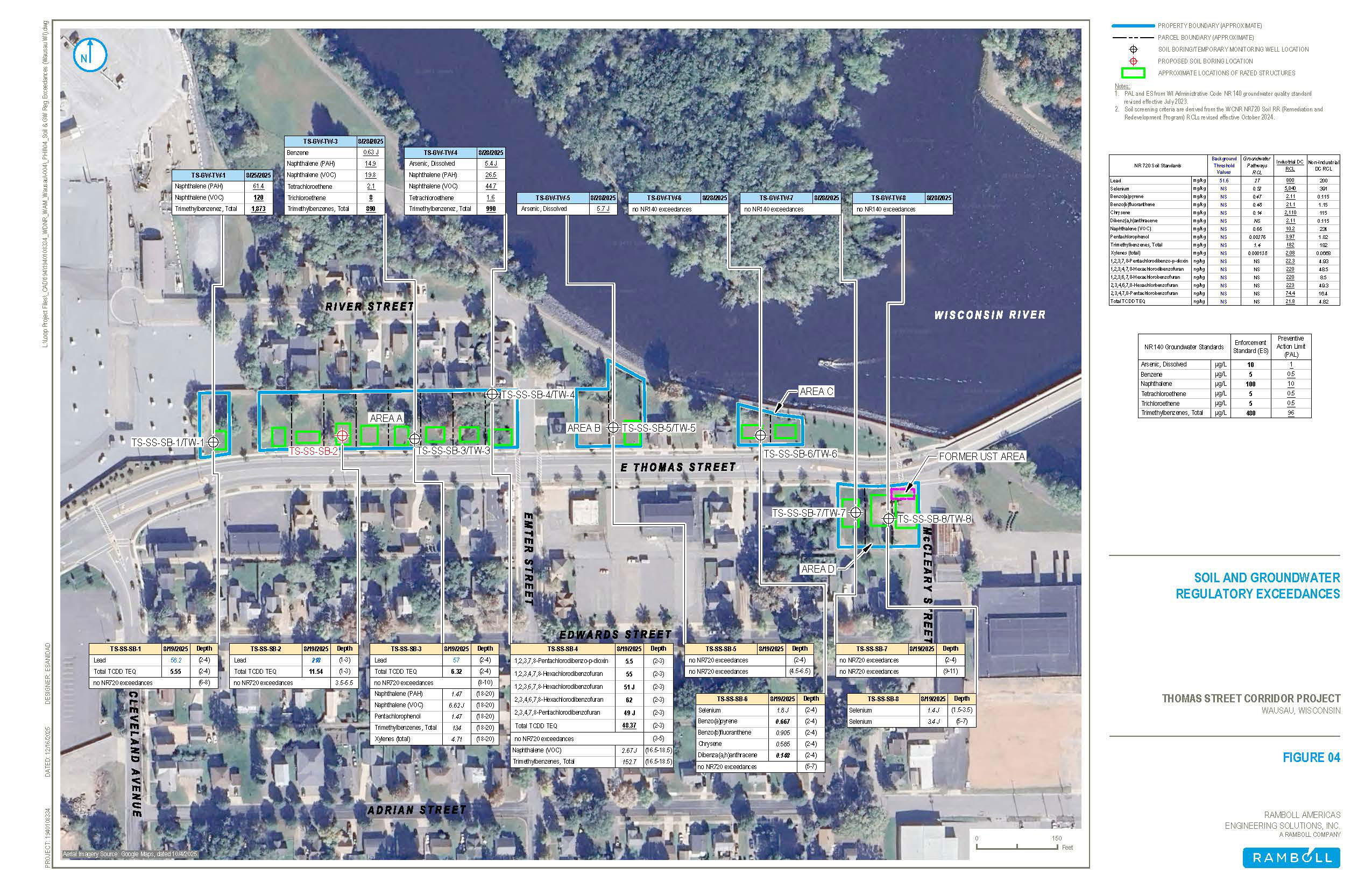
“Area A” Soil Contamination in the DNR’s “Direct Contact Zone” or Top Four Feet of Soil
In the DNR’s “direct contact zone” (or top four feet of soil), levels of lead and concentrations of multiple dioxins and furans exceeded the state’s non-industrial limits (or RCLs — Residual Contaminant Levels), as did dioxin TEQ levels for several parcels in Area A, according to the consultant’s report. At least one soil sample’s dioxin TEQ level exceeded the DNR’s industrial direct contact limit or RCL.
Evidently, and significantly, four separate property parcels in Area A had dioxin TEQ levels exceeding the DNR’s NR 720 non-industrial direct contact RCL. The TEQ levels are listed in site layout exceedance map. These dioxin levels ranged from a dioxin TEQ of 5.5 ng/kg to 48.37 ng/kg. The DNR’s NR 720 non-industrial direct contact RCL for dioxin TEQ (based on the 2,3,7,8-TCDD equivalent) is 4.82 ng/kg.
It is important to note that, in relation to offsite soil contamination near the Koppers property in Superior, WI, the DNR proposed using a cleanup level for dioxin soil contamination on non-industrial residential properties of 5 ng/kg dioxin TEQ because that level is what the department stated that it felt was protective of human health and the environment. In regard to the offsite area in Superior, this cleanup level suggests that soil with a concentration higher than 5 ng/kg dioxin TEQ on non-industrial properties (other than on specific “recreational” property) was to be addressed or “cleaned up.” Based on the cleanup levels that the DNR proposed in Superior, the dioxin TEQ of all four of these parcels in Wausau would evidently meet the threshold for such a clean up.
To date, citizens and at least one local official have conveyed information to the DNR indicating that it would be unacceptable to use a less rigorous cleanup level for dioxin soil contamination on Wausau’s southwest side than the DNR used for cleaning up non-industrial properties in Superior.
Click here to view the annotated Soil Clean Up Level Table used by the DNR in Superior, which includes what state regulators found to be appropriate clean up levels for soil dioxin contamination there: a dioxin TEQ of 5 ng/kg for non-industrial properties, a dioxin TEQ of 13 ng/kg for specific non-industrial recreational property, and a dioxin TEQ of 22 ng/kg for industrial properties.
Contamination Deeper Than the Soil’s Top Four Feet or Direct Contact Zone | Possibly the Highest Dioxin TEQ Level Ever Identified in the Soil of a Non-Industrial Property in Wausau
Soil contamination deeper than four feet in Area A which exceed the DNR RCLs — like groundwater pathway RCLs, as one example — include contaminant’s like pentachlorophenol and PAHs (Polycyclic Aromatic Hydrocarbons), according to the report.
Of significance are test results from a soil sample from boring TS-SS-SB-4 at a 16.5 to 18.5 feet depth that show a dioxin TEQ level of 1,371 ng/kg (or nearly 1.4 parts per billion) and a soil sample from boring TS-SS-SB-3 at an 18 to 20 feet depth with a dioxin TEQ level of 2603.34 ng/kg (or roughly 2.6 parts per billion). For comparison, to demonstrate how high these dioxin levels from the soil samples are, the DNR’s industrial RCL in Wisconsin for dioxin TEQ in soil is around 22 ng/kg. This TS-SS-SB-4 level is over 60 times that value and the TS-SS-SB-3 level is over 118 times that value, which possibly makes them some of the highest, if not the highest, dioxin TEQ levels ever identified in the soil of a non-industrial property in Wausau.
It is worth mentioning that general DNR information states, “Residual contamination within the smear zone is regulated as soil contamination – even if the material is occasionally saturated due to fluctuations of the water table.”
If this high level of dioxin contamination deep in the soil does possibly exist in the smear zone, where it has been impacted in the past by contaminated groundwater, then it presumably raises a variety of reasonable questions, since historical groundwater contamination in the neighborhood has infiltrated into the sanitary sewer and has been discharging into the nearby Wisconsin River for decades. No pipe has been discharging into the river, rather the subsurface area where contaminated groundwater flows into the river has been the DNR’s concern.
If some of the soil contamination at that depth is indeed related to the smear zone and contaminated groundwater, past citizen questions and concerns about City of Wausau water main breaks in the neighborhood years earlier — breaks which reportedly increased the normal neighborhood groundwater level elevation by multiple feet before being repaired, and which are referenced in DNR records — could possibly gain more relevance to environmental aspects.
Citizens for a Clean Wausau is a volunteer group comprised of laypeople. For official information about, or regulatory questions on, local environmental contamination, please contact the Wisconsin Department of Natural Resources (https://dnr.wisconsin.gov/) or the relevant government agency.